Course Navigation
Course home: Probability and Statistics
Assignment: Problem Set 1
Reference: Casella and Berger, Statistical Inference, 2nd ed., Chapter 1
Problem Set 1 / 习题集 1
1. CB 1.6
Problem
Two pennies, one with and one with , are to be tossed together independently. Define
Can and be chosen such that ? Prove your answer.
Solution
The probabilities of obtaining zero, one, and two heads are
If , then each probability must equal . Moreover,
Thus
which contradicts . Therefore, no choices of satisfy
2. CB 1.13
Problem
If and , can and be disjoint? Explain.
Solution
Since
the Bonferroni inequality gives
Hence and cannot be disjoint.
3. CB 1.26
Problem
A fair die is cast until a appears. What is the probability that it must be cast more than five times?
Solution
The die must be cast more than five times exactly when no appears in the first five casts. Therefore,
4. CB 1.41
Problem
As in Example 1.3.6, consider telegraph signals “dot” and “dash” sent in the proportion , where erratic transmissions cause a dot to become a dash with probability and a dash to become a dot with probability .
(a) If a dash is received, what is the probability that a dash has been sent?
(b) Assuming independence between signals, if the message dot-dot was received, what is the probability distribution of the four possible messages that could have been sent?
Solution
Let and denote that a dot and a dash are sent, respectively, and let and denote the corresponding received signals. The sending proportions and transmission probabilities are
(a)
By Bayes’ rule,
(b)
For one received dot,
Because the two signals are independent, conditional on receiving dot-dot the possible sent messages have probabilities
Sent message Conditional probability dot-dot dot-dash dash-dot dash-dash The four probabilities sum to .
5. CB 1.51
Problem
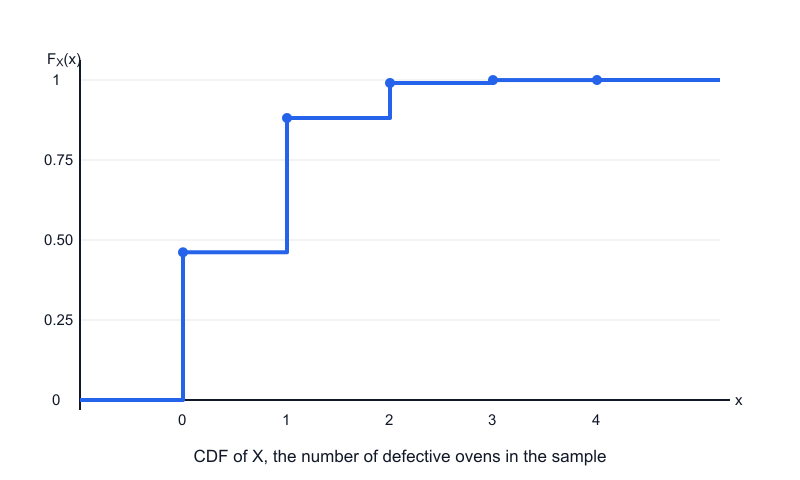
An appliance store receives a shipment of microwave ovens, of which are (unknown to the manager) defective. The store manager selects ovens at random, without replacement, and tests to see if they are defective. Let number of defectives found. Calculate the PMF and CDF of and plot the CDF.
Solution
The number of defective ovens in a sample of four has a hypergeometric distribution. For ,
Since , the PMF is
Decimal value The CDF is
Figure 1. CDF of the number of defective ovens in the sample.
6. CB 1.53
Problem
A certain river floods every year. Suppose that the low-water mark is set at and the high-water mark has distribution function
(a) Verify that is a CDF.
(b) Find , the PDF of .
(c) If the low-water mark is reset at and we use a unit of measurement that is of that given previously, the high-water mark becomes . Find .
Solution
The complete CDF is
(a)
is nondecreasing and right-continuous. In addition,
Hence satisfies all the conditions of a CDF.
(b)
Differentiating the CDF on its continuous part gives
The value assigned at is irrelevant for a PDF. Also,
(c)
Let . Since , we have . For ,
Therefore,
7. Missiles / 导弹
Problem
Suppose we have three missiles: missile 1, missile 2, and missile 3. Suppose each missile is able to hit the enemy plane with probability .
(i) Without extra information, give a lower bound for the probability of the event “all missiles hit the enemy plane.”
(ii) If the three missiles are launched independently, what is the probability that the plane is hit?
Solution
Let be the event that missile hits the plane. Then
(i)
Without any assumptions about dependence,
Thus,
(ii)
If the missiles operate independently, the plane is hit unless all three missiles miss. Hence
8. Integer-Valued Random Variable / 整值随机变量
Problem
Suppose is a random variable taking integer values, , and . Find in terms of and .
Solution
Let
Then and . By inclusion-exclusion,
Therefore,
9. Sigma Algebra / σ-代数
Problem
Consider the random experiment of rolling a die, which gives rise to the sample space
Let
Is a sigma algebra? Explain why.
Solution
The collection
is not a sigma algebra. For example, , but its complement is
Thus is not closed under complementation, so
10. Medical Test / 医学检验
Problem
Suppose a patient walks into a hospital to get tested for a disease that affects of the total population. Let denote the event that the patient has the disease, and let denote the event that the patient’s test is positive. Suppose the testing procedure has sensitivity and specificity:
(i) Find .
(ii) Suppose the proportion of the total population affected by the disease is instead of . Find as a function of . How does it change with ?
Solution
The test has sensitivity and specificity equal to :
(i)
With disease prevalence , Bayes’ rule gives
Thus a positive test corresponds to a disease probability of approximately .
(ii)
If , then
Moreover,
Therefore, is strictly increasing in the disease prevalence .